
Underwater Lifting Bags
Buoyancy Underwater Lift Bags are specialized inflatable devices used to provide controlled lifting force for recovering, moving, or supporting submerged objects underwater. They operate on the principle of buoyancy, where air introduced into the bag displaces water and generates an upward lifting force. These lift bags are widely used in marine salvage, commercial diving, underwater construction, offshore operations, ship repair, and emergency recovery missions.
Constructed from heavy-duty, high-strength coated fabrics, underwater lift bags are designed to withstand harsh marine environments while providing reliable and safe lifting performance. Divers attach the lift bags to submerged objects and gradually inflate them with compressed air. As the bags fill with air, they create positive buoyancy, enabling the controlled lifting, positioning, or recovery of heavy underwater equipment, vessels, pipelines, anchors, and other submerged structures.
Modern underwater lift bags are equipped with safety features such as pressure relief valves and dump valves that allow precise control of buoyancy during ascent, reducing the risk of uncontrolled lifting. Depending on the application, multiple lift bags can be used together to distribute lifting forces evenly and ensure stability of the load.
Underwater lift bags are available in various configurations, including Open Bottom Parachute Bags, Enclosed Lift Bags, Pontoon Lift Bags, Tetrahedron Lift Bags, and Pillow-Type Lift Bags. Each design is suited to specific lifting and flotation requirements, ranging from deep-water salvage operations to surface buoyancy support and underwater construction projects.
Lift Bag Features
- High Lifting Capacity
- Heavy-Duty Construction
- Compact and Portable
- Controlled Buoyancy
- Integrated Safety
- Corrosion-Free Operation
- Versatile Attachment Options
- Rapid Deployment
- Multiple Designs Available
- Low Maintenance Requirements

Marine Salvage & Diving Bags
Enviroguard marine salvage bags feature a totally enclosed cylindrical design, commonly known as enclosed air lift bags, inflatable buoyancy units, or salvage pontoons.
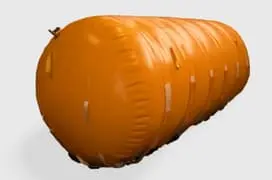


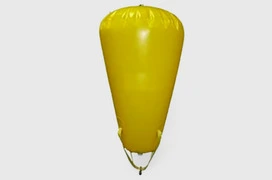
Marine Salvage Applications
- Marine Salvage Operations.
- Ship Repair and Maintenance.
- Offshore Oil & Gas Projects.
- Underwater Construction.
- Port and Harbor Maintenance.
- Pipeline and Cable Installation.
- Military and Naval Operations.
- Scientific and Research Projects.
- Emergency Response Operations.
- Aquaculture and Marine Engineering.
Capacity & Specifications
| Model | Lift Capacity | Diameter | Height | Style | Best For |
|---|---|---|---|---|---|
| ULB-50 | 50 kg | 500 mm | 600 mm | Parachute | Small salvage |
| ULB-250 | 250 kg | 800 mm | 1150 mm | Parachute | Diving recovery |
| ULB-500 | 500 kg | 1000 mm | 1450 mm | Enclosed | Marine equipment |
| ULB-1000 | 1 Ton | 1250 mm | 2050 mm | Enclosed | Heavy salvage |
| ULB-2000 | 2 Tons | 1700 mm | 2450 mm | Pontoon | Industrial lift |
| ULB-5000 | 5 Tons | 2300 mm | 3600 mm | Pontoon | Commercial ops |
| ULB-Custom | 10-100 Tons | Custom | Custom | Tetrahedron/Pontoon | Major projects |
What lifting capacities are Enviroguard's underwater lift bags available in?
Our underwater lift bags are manufactured in capacities from 100 kg to over 50 tonnes. For heavier salvage jobs, multiple bags can be rigged in parallel to distribute the load across attachment points. Tell us the submerged weight of what you're lifting and we'll size the bag.
At what water depth can Enviroguard lift bags be used?
Standard lift bags are rated for depths up to 50 metres. For deeper salvage or offshore operations, reinforced deep-water variants are available. Depth matters because hydrostatic pressure changes the bag's effective buoyancy — a bag rated at 10 tonnes at surface provides less net lift at 40 metres.